
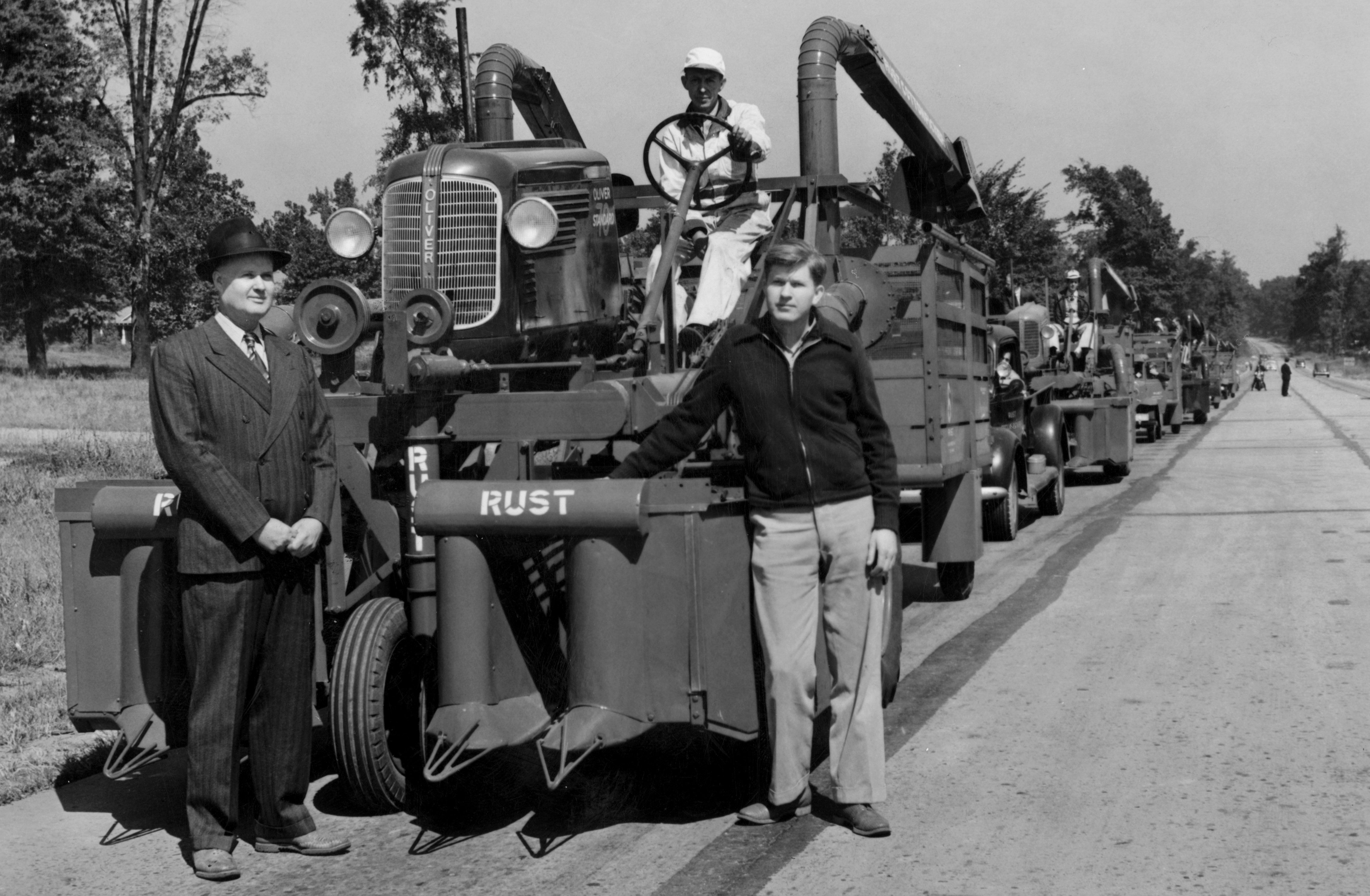
Mack Rust, who outlived his older brother John by 12 years, never abandoned his quest to build a better cotton picker but later struggled to secure financing on his own — something he blamed on John.
In 1962, he turned to a relative, S. Murray Rust Jr., seeking $5,000 to help commercialize his designs.
In a letter to his cousin, Mack wrote that he hoped to line up a manufacturer to build machines superior to those made by Ben Pearson Inc. and Allis-Chalmers, the two companies that had acquired licenses from John before his death.
Even though Mack had been integral to the brothers’ inventions, he received neither money nor credit for the Rust-branded machines that began rolling off the companies’ assembly lines in 1948.
Not only was Mack asking Murray for financial help, but his letter also sought to correct the record — and perhaps refute an Arkansas judge’s ruling in 1956 that Mack “did nothing to contribute to the picker produced by Allis-Chalmers Corporation or by Ben Pearson.”
The ruling, which rejected Mack’s bid for a share of royalties, clearly stung, but it wasn’t the first time his contributions had been dismissed.
John, who had long been the primary beneficiary of widespread news coverage about the brothers, in 1952 relegated Mack to a supporting role in the cotton picker story.

In a 32-page manuscript titled “The Origin and Development of the Cotton Picker” (downloadable PDF below), John spends the first 14 pages providing a broad overview of the history of cotton, beginning with the Greek historian Herodotus and extending through a pantheon of notable 18th-century inventors — from James Hargreaves, the father of the spinning jenny, to Eli Whitney, whose saw-tooth gin successfully separated cotton lint from seeds, thereby strengthening the hold of King Cotton and slavery in the American South.
John then recounts his oft-told story of how the idea of using a smooth wire spindle to pull fibers from ripe cotton bolls came to him late one night in 1927, after he had gone to bed.
Mack enters the picture on page 18, when he joins his brother in Texas, “bringing with him an automobile, a typewriter, and a few hundred dollars he received for a piece of property he sold.” Though the brothers shared nine patents in the 1930s, including the first, John notes that their last joint patent was filed in 1936, “a few years before my brother moved his operations to Arizona.”
World War II derailed their progress. The brothers could not secure financing, and they and their spouses had to find outside employment. Tennessee revoked their company’s charter for failure to pay franchise taxes. It is at this point that Mack exits John’s narrative: “My brother became convinced that he would never amount to anything unless he got out on his own. So he moved his operations to Arizona.”
Mack, in his letter to Murray, included a timeline titled “Rust Cotton Picker, 1928-1962” (PDF below) that offered a fuller explanation of that period. He describes how he spent months on the road in early 1942 demonstrating the pickers to farmers in the Mississippi Delta. Then, after learning that a late crop was available for harvesting in Arizona, he took three of the company’s machines there, where his demonstrations proved productive.
“A broad section of Arizona cotton people” were impressed by the Rust Picker, Mack writes, and they helped support efforts to convince the USDA War Board to greenlight production. Mack, who went to Washington to lobby the War Board, also suggests that Allis-Chalmers, which “had previously been highly skeptical of the Rust Picker’s potential,” changed its tune and initiated talks — with John.
“The license was set up with John acting as sole adviser on RCP details and with returns from the contract channeled into John’s hands,” Mack writes.
Then Mack, a University of Texas engineering graduate, gets to the point: “Machines built during the first two years of the contract, according to John’s specifications and approval, proved quite unfit for mass production, as evidenced by the A-C (Allis-Chalmers) Company spending another three or four years attempting to design and build a model that could be successfully marketed.”
Both the Allis-Chalmers and Ben Pearson machines performed poorly, Mack says.
“During the period from 1949 to about 1953 the two companies sold more than 2,000 machines and paid royalties totaling well over a million dollars. By the end of this period, the purchasers of these machines had learned to their sad regret that the machines as built by both A-C and BP (Ben Pearson Co.) had so many mechanical bugs that they could not be kept running with any satisfactory degree of continuity. And the reputation of the name ‘Rust’ on cotton pickers took a nosedive.”
Because John cut him out of the licensing deals, Mack says he “was unable to draw any benefits from those two deals (and) was actually handicapped and hindered in various ways in my work due to the very existence of them.”
“The complete fiasco which resulted from the first output of machines by both licensees made a bad name for the Rust type picker and reacted adversely on my efforts to procure a license or to promote money to carry on my work.”
Mack died in Coalinga, California, on Jan. 11, 1966, the day before his 66th birthday. From 1951 through 1961, Mack had been issued eight patents in his name alone.
Unlike his brother’s death in 1954, which garnered headlines nationwide, Mack’s passing went largely unreported.

Leave a Reply