
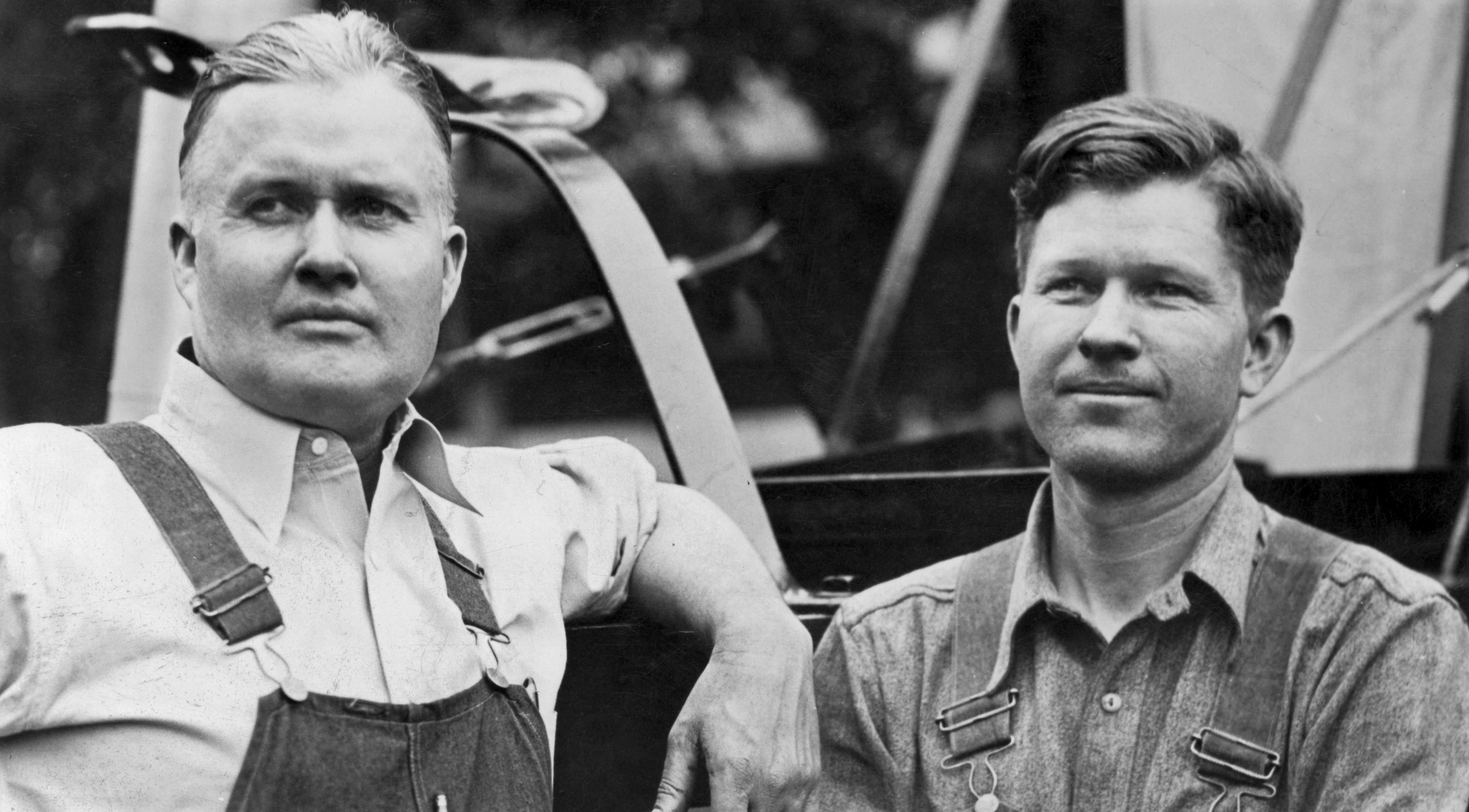
After his parents died, he wandered. Picked cotton. Harvested wheat. Mined coal. Lived in a cooperative community. Drafted during the Great War, he never fought. Learned instead to play the bugle.
Along the way, John Daniel Rust took correspondence courses and devoured socialist political tracts about an America where labor would be respected and poverty eradicated.
In 1928, the twice-divorced drifter, now living with a sister, ran for the U.S. Senate as the candidate of the new Workers (Communist) Party in Texas.
“The overthrow of the present system and the substitution of a workers’ and farmers’ government” was the goal, the 36-year-old candidate told the party’s newspaper, The Daily Worker.
Rust received just 114 votes. Tom Connally, a staunch segregationist and a Democrat, won the general election with 566,139.
Rust — joined by his younger brother, Mack — had moved back to Texas, aiming to build a commercially successful mechanical cotton picker.
That work — John thought he’d discovered the key to success, a unique type of spindle — would consume the rest of the brothers’ lives, even after they went their separate ways.
Their efforts drew inordinate news coverage in the mid-1930s, something the Rusts — especially John — were happy to stoke.
Because a mechanical cotton picker had the potential to displace more than a million people — most of them Black southerners — the implications were inescapable. A cotton-picking machine, if adopted, would end the oppressive conditions of the plantation system, but it would also mean vast unemployment — an untenable possibility during the Great Depression.
The Rust brothers recognized that potential impact, and leaning into their socialist ideals, floated the idea of diverting profits from the machines to helping displaced labor, making their machines available to cooperative farms, and dictating minimum and maximum wages for planters that used their machines.
In 1936, they solemnly pledged to lease their pickers only to farmers who agreed to pay a living wage and recognize collective bargaining. The top executive of a corporation that used their machines could not earn more than 10 times the salary of its lowest full-time paid employee, the Rusts said.
Time magazine was among news outlets drawn to the Rusts’ idealism: “Far from being rapacious money-getters, the Brothers Rust, professed Socialists, were willing to forgo profits rather than deliver a body blow to Southern labor.”

The brothers didn’t think they could solve the labor challenges by themselves.
“As much as we are concerned with the welfare of the people who will be disemployed by the cotton picker,” John Rust told the Memphis Press-Scimitar, “it is obvious that we will not be able to rehabilitate all of them from our share of the profits. We believe there should be a job for every able-bodied person who applies for work, and there should be universal insurance for the disabled and the aged. But these are social problems which must be dealt with as such by society as a whole.”
The press in the United States largely downplayed the Rusts’ politics — and none of the coverage ever mentioned John’s Senate race in 1928. Not even the Daily Worker.
The Soviet Union, which was trying to develop cotton production, was looking at cotton picker prototypes in the U.S., and ordered two machines from the Rusts in 1935. John and Mack went to USSR to test their prototypes, hoping to produce the machines there.

In a feature about the Rusts in 1936, John talked about the enormous challenges ahead for the U.S.
“The final solution will come with the introduction of a planned economy of abundance, based on production for use,” John told The Daily Worker. “Some form of cooperative commonwealth must supplant our decaying capitalist system. Under such a society, new inventions will no longer take the worker’s job; they will shorten his hours of toil. We Americans have proved ourselves to be good mechanical engineers. Now let’s turn our hands to social engineering, and build a new society.”
John and Mack were more successful at promoting their machines to the press than they were at building and selling them. In 1939, they signed a contract to assemble the machines at a New Deal-backed factory in West Virginia, but only five were produced there and the factory took a significant loss.
By 1940, they’d hit a wall. John, Mack and their wives (John had remarried in 1933) were forced to find full-time work to stay afloat. Any hope of raising capital to finance production of new machines was dashed by the U.S. entry into World War II, when the war production board would not recognize mechanical cotton pickers as essential.
The demand for labor from the military and war industries changed things. As cotton growers and other farmers struggled to find workers, mechanization made sense.
When International Harvester announced in 1942 it had a production-ready model, other manufacturers scrambled to enter the market.
In 1943, Deere & Co. acquired the Berry patents instead of the Rusts’.
E. Marshall Rust, a relative who supported the brothers financially, speculated that Deere may have chosen the “not much good” Berry patents because of the Rust brothers’ political leanings.
“Some years ago, the Rust Brothers came out with the idea that showed they were inclined toward Socialism,” he wrote in private correspondence in early 1944. “I think that is what hurt them; these people thought something must be wrong with them to believe such trash.”

Whether there was any basis to that speculation is unknown. John’s politics did not deter another major manufacturer from doing business with him. Allis-Chalmers, which struck a deal with John in 1944, produced pickers under a Rust license from 1948 until the 1960s. Then in 1949, John struck a separate licensing deal with Ben Pearson Inc. of Pine Bluff, Arkansas. (That company, and its successors, made pickers until 1977.)
John died of a heart attack in January 1954.
The Pine Bluff Commercial, which called Rust the city’s “first citizen,” eulogized the inventor as a man who’d “seen the ragged, hungry, seamy side of life and somehow along the way had decided it didn’t have to be like that… There was one idea that he held unshakably: he was convinced of the essential dignity of men. His completely unostentatious giving bears testimony to this belief. John Rust had the spirit of a liberal.”
That liberal spirit, of course, has largely disappeared from rural America, where farming long ago turned into agribusiness and a handful of multinationals now control production of seed, chemicals and equipment.
That wasn’t John or Mack’s vision.

David Halberstam wrote the coda to the Rust story in his book, “The Fifties,” pointing out that Rust’s widow, Thelma, eventually “managed to divert the royalties from a foundation he had established to her private estate and to buy a motel in Pine Bluff.”
In late 1954, Thelma gave a talk in Memphis about her husband and his cotton picker.
Thelma’s telling of the Rust story was billed in the Press-Scimitar as “a saga of triumphant achievement in a free enterprise system” — and that’s how it’s misremembered today. — © 2026 Roland Klose. All rights reserved.
For specific dates and other details, go to the Timeline. Updated Feb. 11, 2026, with excerpt from E. Marshall Rust letter.

Leave a Reply