
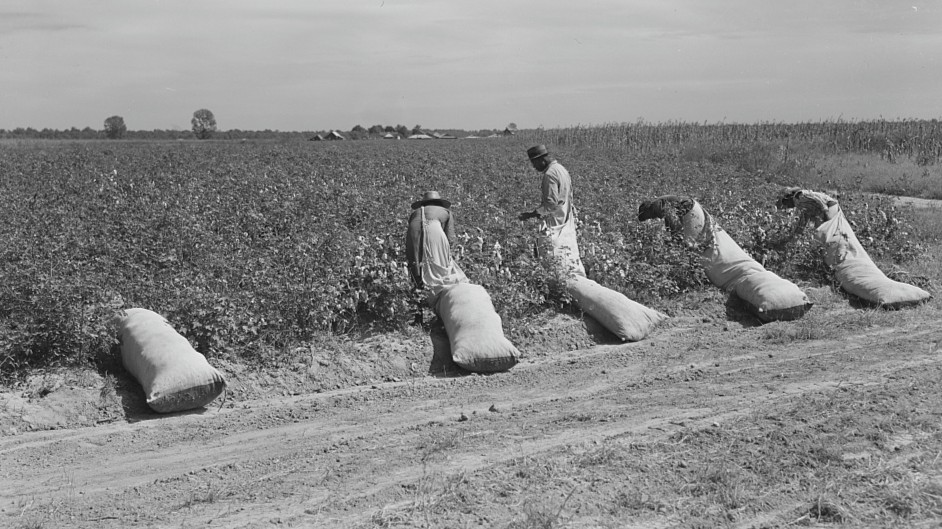
Before the mechanical cotton picker took hold, millions of people, mostly Black southerners, harvested the crop by hand. Emancipation had not spared the descendants of enslaved people from the drudgery of “cotton-picking time.”
The work was difficult and the pay was meager, but there were few alternatives for unskilled workers in the rural South or for the white growers who relied on a standing army of cheap labor.
Poverty and racism — and the laws that preserved both — worked in the growers’ favor, as did debt servitude, convict leasing, and barriers to labor organizing.
As the nation entered the modern era of automobiles, airplanes, tractors, and radio, new technology threatened to upend a system built on peonage and hand labor. Cotton, however, posed unique challenges to mechanization. Unlike other row crops such as corn and wheat, cotton bolls didn’t ripen uniformly, plants varied in height, and stalks, leaves, and other trash easily commingled with the fiber during harvesting by machine.
The mechanical picker prototypes that were demonstrated in the first half of the 20th century were not up to the challenge and proved too costly for most farmers.
“I don’t want one — it wastes too much cotton and gets too much trash,” said Pat “Bones” Barcroft, a Greenville, Mississippi, grower who watched a Rust picker at a field trial in 1936.
Watching at the same demonstration, Oscar Johnston was less dismissive, calling the Rust machine “basically practical” but in need of “improvements.”
Johnston, manager of the sprawling Delta and Pine Land Company plantation, then the world’s largest plantation, was an influential voice in the cotton trade. He told the press if the mechanical picker was successful, “it will be the death knell for family-size farms and for tenants.”

John and Mack Rust recognized that their invention would displace labor, and during the Depression, when jobs and money were scarce, that was a top concern — one raised frequently by the press.
The American Mercury, writing about the Rust invention in February 1935, got to the point:
“It means that great masses of hand-pickers who flock into the cotton fields every fall from the cities, towns and villages of Dixie, will be unnecessary. Their chief source of income will have been wiped out. It means that the greatest single source of child and woman labor in America will be abolished because it will be economically too expensive to continue using it, no matter how cheap it can be obtained, in comparison with a tractor-operated mechanical picker.”
Progressives, however, embraced the possibilities, provided the rollout of the machine was coupled with efforts to mitigate the hardships that the working poor would face.
“It will mean a revolution in cotton, it will free an enslaved people,” said H.L. Mitchell, a leader of the Southern Tenant Farmers Union, after watching a film in 1935 of the Rust picker in action.
“For a time, it might deprive them of livelihood, but social adjustments will have to be made to care for them,” Mitchell continued. “You cannot let that stand in the way of progress. History is but a series of social changes brought about by new inventions.”
“Planters are just as concerned over this as laborers,” Mitchell, said. “They fear its social consequences and are unable to offer a solution. But to them it offers the opportunity to grow more cotton cheaper than anywhere else in the world. To the laborer it means freedom from the slavery of King Cotton.’”
Southern reactionaries, faced with the end of plantation politics, saw things differently.
The Jackson, Mississippi, Daily News, called for sinking the Rust machine in the Mississippi. And Ed Crump, the Democratic political boss of Memphis, called for laws to ban mechanical cotton pickers.
“There should be legislation in every state,” Crump demanded.
Of course, there wasn’t — and the start of World War II quickly changed the narrative. Military service and the lure of higher-paying war jobs stoked a sudden labor shortage in the Cotton Belt. How the segregated South responded is eye-opening for people who didn’t live in that era.
In the Memphis area, public school officials decided to close schools for nearly two months in the fall of 1942 to send thousands of kids into the fields. The closures, however, mainly affected “Negro schools, … so negro children, from toddlers to teen-age huskies, can help pick cotton,” the Press-Scimitar reported. (One nearby exception was Tunica County, Mississippi. There, the schools for Black children didn’t open until the end of November — after the cotton crop was already gathered, superintendent Florence Nelson told the newspaper.)
Despite the end of the war in the 1945, the struggle to recruit farm workers persisted, prompting cotton growers to lean on the federal government to help import thousands of workers from Mexico. (Unions opposed the move. H.L. Mitchell, now with the National Farm Labor Union, said importing Mexicans was just a way to cut picking rates and undermine collective bargaining. “We have plenty of labor to harvest the crop,” he said. “If the growers will pay fair wages and accord their pickers fair and just treatment, they will have no trouble in getting the crop moved.”)
By the 1950s, though, mechanical pickers, including thousands made under license to John Rust, were showing up across the South — and the dire predictions about the impact on labor were appearing to come true.
So many Black southerners were displaced by the mechanization of cotton farming starting in 1950, job opportunities for Black workers were affected nationwide, sociologists Harry C. Dillingham and David F. Sly wrote in a paper published in 1966.
That economic dislocation and unemployment helped explain the racial unrest that boiled over during the Civil Rights Movement of the 1960s.
“The tendency to look upon the racial crisis as a struggle for equality between Negro and white is too narrow in scope,” Dillingham and Sly wrote. “The crisis is caused not so much by the transition from slavery to equality as by a change from an economics of exploitation to an economics of uselessness.”
Donald Holley, who wrote about the mechanical picker and migration in “The Second Great Emancipation” (2000), discounted Dillingham and Sly’s analysis, saying it was based on data gleaned from a sample of Arkansas Delta counties — “evidence not sufficient to form a judgment.”
Holley said while there was a correlation between Black tenants and mechanical pickers, it was unclear whether the pickers drove out tenants or mechanization was a response to the labor shortage.
In an interview with International News Service in 1939, John Rust told a reporter, “The Civil War freed the chattel slaves of the South. We hope to free the sharecroppers.”
It turned out the sharecroppers, tenant farmers, and pickers were, in fact, set free — though not in the way Rust had envisioned. — © 2026 Roland Klose. All rights reserved. Revised on Feb. 9, 2026.

Leave a Reply